
I haven’t done a Tuesday Travels post in a while but today we’re revisiting Dublin in honor of the 105th anniversary of Ireland’s Easter Rebellion.
The uprising began on April 24, 1916 while the United Kingdom was in the midst of World War I. Rebels from the secretive Irish Republican Brotherhood, led by Patrick Pearse, streamed into Dublin from the countryside. The armed men attacked government buildings and seized the General Post Office. After initial success, they declared Irish independence.

The historic General Post Office, Dublin, Ireland.
However, the British launched a counteroffensive and the rebellion was crushed after only five days. The Irish people were initially not supportive of the rebellion, but the harsh measures meted out to the rebels stirred public resentment. The leaders of the uprising, including Pearse and James Connolly, were executed and became instant martyrs. When I visited Dublin Castle, we learned about the execution of the prisoners and visited a room dedicated to their memory.

Armed protests broke out and in 1921, a vote was held. 26 of Ireland’s 32 counties voted for independence and the Irish Republic was born. The other counties remain part of Northern Ireland, in the United Kingdom.

When I was in Ireland, we took a day excursion to west County Cork where I saw this statue of Michael Collins, who participated in the Easter Rebellion and went on to be a leader of Sinn Fein and the Irish Republican Army. In Jan. 22, he became Chairman of the Provisional Government of the Irish Free State until his assassination in August 1922.
Irish history is turbulent and disturbing, but quite fascinating. I’d love to see more of the Emerald Isle some day.
Linda
 I saw this house in a small village we visited on the way to Bath and immediately thought, that’s the house Elinor escapes from! I could almost see her peering out of one of the upstairs windows, dreaming of escape and adventure. What I didn’t realize at the time is that some of my ancestors came from the same general area in Wilshire. Now I can’t wait to go back and visit again.
 In London, we saw Hyde Park, a bit of a disappointment since we were there during a time of drought and the grass was dried up and brown, as you can see from the photo. I’m sure it was much prettier in Elinor’s time.
 One of the fun things my traveling companion and I did was go to London early in time for the annual London Open House. We got to tour some private residences, including one on Berkeley Square, prime real estate now and back in Elinor’s time. The famous London plane trees (sycamores) are a lot taller now than they were during the Regency.
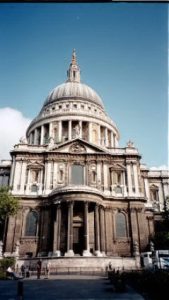 Elinor and Stephen visit St. Paul’s Cathedral in one scene. Val and I enjoyed exploring Wren’s magnificent church, with its distinctive dome. The interior is just as impressive.